
The Facts of Roulette
Reading Online Roulette Variants: What Actually Differs Between European, American, and French Wheels
Online roulette catalogues list several variants that look almost identical at first glance. All of them use the same wheel of red and black numbered pockets and the same layout of inside and outside bets, and what separates them is the wheel structure itself and, in one variant, a rule that reshapes the mathematics for a subset of bets. Those small differences produce genuinely different expected outcomes over time.
 There are occasions when we here at ReadyBetGo want to bring you interesting facts about the gambling industry When something catches our eye, we will publish it for your enjoyment.
Any UK-facing catalogue with a roulette section will list European roulette in the majority position, American roulette present but less common, and French roulette at the larger catalogues. This piece walks through what distinguishes the three variants and how the choice affects a player's expected cost per hour of play.
The Three Variants at a Glance
The variants differ on two dimensions: the wheel structure (how many zero pockets are present) and the rules that apply on those pockets. Historical development of both structures traces back to the game's late-eighteenth-century French origins and the nineteenth-century divergence between European single-zero and American double-zero conventions.
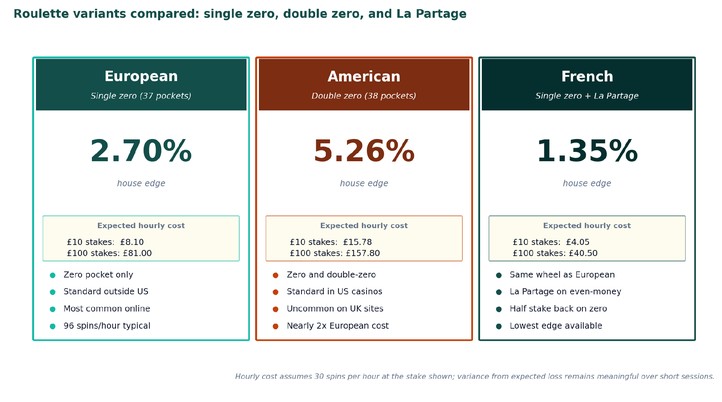
The mathematical summary is straightforward. European roulette carries a house edge of 2.70 percent on every bet, American roulette carries 5.26 percent on every bet (roughly double the European figure, entirely because of the extra double-zero pocket), and French roulette uses the European wheel but applies additional rules that cut the house edge on even-money bets to 1.35 percent. The rest of this piece walks through each variant in turn.
European Roulette: The Single-Zero Standard
European roulette uses a 37-pocket wheel with numbers 1 through 36 plus a single green zero. The house edge sits at 1/37, or 2.70 percent, on every bet type on the wheel. This is the standard configuration outside the United States and is by far the most common variant on UK-facing sites.
The single-zero structure was introduced by the Blanc brothers in 1842 at a spa casino in Bad Homburg, in direct competition with the double-zero wheels dominating French casinos. The lower house edge attracted players, the wheel spread through Europe, and by the late nineteenth century single-zero had become the continental standard.
For an online player, European roulette is the default choice on almost every UK-facing catalogue. The Fruity King roulette games listing shows this pattern clearly, with European tables carrying both software and live dealer variants. The house edge is uniform across bet types, the mathematics is well understood, and both software and live dealer versions are widely available.
American Roulette: The Double-Zero Cost
American roulette uses a 38-pocket wheel: the same 1-through-36 numbering plus both a single zero and a double zero. The extra pocket increases the house edge to 5.26 percent on almost every bet type, roughly doubling the expected cost per unit staked compared with the European wheel.
The double-zero configuration is the older form. Both zero pockets appeared on early nineteenth-century French wheels before the Blanc brothers dropped one, but the double-zero survived in the United States after the game crossed the Atlantic. Nevada legalisation in the 1930s cemented double-zero as the American standard, and it spread from there to Caribbean and Latin American casinos.
For UK online players, American roulette is present on many catalogues but rarely a good choice for pure play value. The double-zero adds no gameplay dimension worth the extra 2.56 percentage points of house edge, and the standard advice for a player who cares about expected cost is to avoid American tables when a European version is available.
French Roulette: La Partage and 1.35 Percent
French roulette uses the same 37-pocket single-zero wheel as European roulette. The mechanical difference is not in the wheel but in a rule called La Partage, applying to even-money bets (red/black, odd/even, high/low). When the ball lands on zero, La Partage returns half the stake on any losing even-money bet rather than taking the full stake.
The mathematical effect is significant. For even-money bets, the house edge drops from 2.70 percent to 1.35 percent, which is the lowest house edge available on any standard roulette variant. The rule does not apply to inside bets (straight numbers, splits, corners), which retain the 2.70 percent European figure.
Some French roulette tables also offer En Prison, a related rule under which a losing even-money bet is held in place on zero rather than half-refunded, and settled on the next spin. En Prison produces the same expected value as La Partage but is less common on modern online catalogues. Where both are offered, they are equivalent from a bankroll perspective.
What This Means in Practice
The comparison card sets out the per-hour cost difference at typical online play speeds (roughly 30 spins per hour on a live dealer table, faster on software). At £10 stakes, European roulette costs a player around £8 per hour in expected loss, French roulette around £4, and American roulette close to £16. Britannica's roulette entry gives the underlying wheel and rule history that produces these figures.
These are expected values over long sessions rather than guarantees. Variance across any short session is meaningful, and a player can lose several hundred pounds in an hour on any variant if the wheel runs against them, or come out ahead on any variant if it runs favourably. The house edge describes the long-run direction of the money rather than the outcome of any particular session.
For a player who chooses variants based on expected cost, the ranking is straightforward. French roulette on even-money bets is the strongest option available, European roulette is the standard choice for inside bets and for tables that do not offer La Partage, and American roulette is rarely the right pick if either alternative is on the same catalogue.
What Online Catalogues Typically Offer
Most UK-facing catalogues carry European roulette as the default. Larger catalogues include American and French versions alongside the standard European tables, and the biggest include live dealer variants of all three from studios like Evolution, Playtech, and Pragmatic Play.
Live dealer tables are almost always European variants, since live studios optimise for the most-played configuration. Software tables offer more variety, with French roulette in particular being more commonly available as software than as live dealer content. A player who wants La Partage will generally find it in the software section rather than at a live table.
Reading a catalogue with the variant differences in mind makes the choices legible. Two roulette tables that look identical in the lobby can carry meaningfully different mathematics depending on which wheel and which rules are behind them. Knowing which is which is a small but useful piece of strategic literacy for anyone playing the game with any regularity.